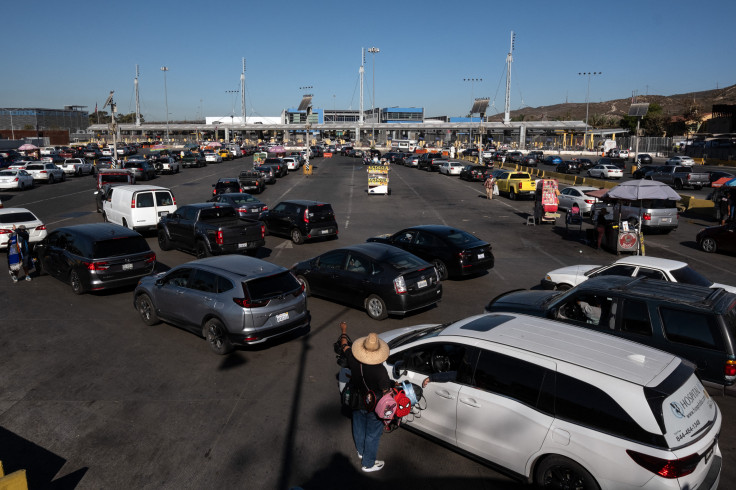
 Cars queue before crossing to the United States at the San Ysidro Port of Entry in Tijuana, Baja California State, Mexico, on November 4, 2024.
GUILLERMO ARIAS/AFP via Getty Images
Cars queue before crossing to the United States at the San Ysidro Port of Entry in Tijuana, Baja California State, Mexico, on November 4, 2024.
GUILLERMO ARIAS/AFP via Getty Images
Small check-cashing counters, grocery stores and money-wiring shops along the U.S.-Mexico border have generated 700,000 currency transaction reports for the federal government since Washington dramatically lowered the dollar amount that triggers mandatory reporting in their neighborhoods. A partially redacted internal memo obtained by the Guardian shows that as of February 23, 2026, 86 businesses were still filing under the requirement — a rule that turns an ordinary cash sale into a federal paper trail complete with a customer's Social Security number and home address.
A Threshold That Kept Dropping, Then Climbing Back Up
The rule traces back to March 2025, when the Treasury Department's Financial Crimes Enforcement Network, known as FinCEN, issued an order covering 30 zip codes in California and Texas, including parts of El Paso, Laredo, San Ysidro and Calexico. It forced money-services businesses there to report any cash transaction over $200 — a fraction of the usual $10,000 trigger. The order took hold that April.
FinCEN eased the number somewhat when it renewed the order in September 2025, raising the floor to $1,000 and, for the first time, pulling in two Arizona counties, Santa Cruz and Yuma. A third version of the order, issued in March 2026 and running through September 2, 2026, pushed the geography further still: three additional New Mexico counties — Bernalillo, Doña Ana and San Juan — plus two more Arizona counties, Maricopa and Pima. By the government's own math, filling out a single report without automated software takes about 24 minutes, a burden owners describe as now touching nearly every sale that crosses the counter.
Owners Say the Wrong People Are Backing Away
Evangelina Ornelas, who co-owns Nachita's Grocery in El Paso, has watched the lines of customers who once came in to wire rent money or cash a paycheck thin out since the paperwork requirement began. "I don't think it was to prevent money laundering," she told the Guardian. She's now winding down that side of the business.
The nonprofit Institute for Justice, which is representing shop owners in separate lawsuits, has pointed to a mismatch between the rule's stated target and what it's actually catching: one of its client businesses had never processed a transaction anywhere near the old $10,000 threshold, and the firm argues that anyone genuinely structuring cash to evade a $200 or $1,000 trigger could simply drive to an uncovered zip code, leaving ordinary customers to absorb the compliance burden instead.
The Ninth Circuit Weighs In
The rule is now snarled in litigation. Esperanza Gomez Escobar, who owns a small money-services business in San Diego, sued FinCEN through her company in Novedades y Servicios, Inc. v. FinCEN, arguing the agency bypassed the public notice-and-comment process the law requires for a rule this broad and that it also amounts to a warrantless search under the Fourth Amendment. On July 13, 2026, a divided Ninth Circuit panel — Judges Lucy Koh and Ana de Alba in the majority, Judge Kenneth Lee dissenting — affirmed an injunction blocking enforcement in the Southern District of California, ruling largely on the notice-and-comment question rather than reaching the Fourth Amendment claim.
Institute for Justice attorney Betsy Sanz, who represents Gomez Escobar, told Courthouse News the order amounts to "a huge invasion of financial privacy." A separate Texas lawsuit brought by the Texas Association of Money Services Businesses produced its own injunction shielding that group's members from the original order; it's unclear whether that case has moved beyond the district court. Outside the businesses covered by these two rulings, the order remains enforceable.
Treasury's Case: This Is About Cartels, Not Communities
Treasury officials reject any suggestion that the order targets immigrant neighborhoods, casting it instead as a tool against drug-trafficking cash. When the original order was announced, Treasury Secretary Scott Bessent said it reflected serious concern about the danger cartels and other criminal networks pose to the U.S. financial system. FinCEN reiterated that framing when it expanded the order again in March 2026, tying the broader footprint to fentanyl trafficking and Mexico-based criminal organizations. Critics counter that the businesses actually swept up by the order mostly serve unbanked, working-class customers rather than large-scale launderers.
A Wider Slowdown in Money Sent Home
The legal fight is playing out as money flows across the border shrink for reasons that go well beyond this one rule. Mexico's central bank recorded remittances falling by nearly $3 billion in 2025, a 4.6% drop that economists tie to a cooling U.S. labor market, a stronger peso and the broader immigration crackdown — not the reporting rule on its own. An earlier mid-2025 projection had put the year's expected loss closer to $3.7 billion; the final Bank of Mexico tally came in somewhat lower than that estimate. How much of the pullback at counters like Ornelas's traces to the reporting requirement itself, versus these larger economic currents, remains genuinely unsettled. For the families who used to walk through her door, the practical effect is the same regardless of which force is driving it away.
© {{Year}} Latin Times. All rights reserved. Do not reproduce without permission.